If ever there was a time when people in positions of power should learn from history, that would be today. And yet we see leaders unable to change the script of campus protests and violence that threaten disaster for Democrats and the country.
For those of you who weren’t around then, 1968 was one of the most horrific years in American history (see timeline here).
That spring, Lyndon B. Johnson, skilled politician though he was, discovered he could not preside over both domestic milestones like civil rights legislation and the far-off Vietnam War, whose purpose and bloody execution Americans increasingly questioned. LBJ had to abandon his reelection campaign after nearly losing the New Hampshire primary election to peace candidate Eugene McCarthy and after Robert F. Kennedy—the real thing, father of the current Jr.—entered the race as well.
The assassinations of President John F. Kennedy in 1963 and Malcolm X in 1965 had helped fan the feeling that the country was out of control, the government unstable and out of touch, and rogue agencies like J. Edgar Hoover’s FBI and elements in the military untrustworthy and mendacious.
Martin Luther King Jr., who had turned against the Vietnam War, was assassinated in April, 1968, an irremediable loss in national leadership leading to widespread riots. RFK was killed two months later, just after winning the California Democratic presidential primary election. The 24-year-old assassin, Sirhan Sirhan, a Palestinian Christian born in Jerusalem, said later that “he felt betrayed by Senator Robert F. Kennedy’s support for Israel in the 1967 Arab-Israeli war” and “killed Mr. Kennedy out of concern for the Palestinians.” That’s how long—and longer—Israel v. Palestine has been contorting our national life. Perhaps not coincidentally, RFK Jr. strongly supports Israel’s actions in Gaza.
Photo by John Filo from Wikimedia Commons: Mary Ann Vecchio kneeling over the body of Jeffrey Miller, one of 4 students shot dead by National Guard, Kent State University, May 4, 1970.
In 1968, students protested and occupied buildings on numerous campuses. Police beat up and arrested protestors in universities and again around the Democratic presidential convention in Chicago (also, ironically, the scheduled 2024 location), where the nomination went to Vice President Hubert Humphrey, who had not entered primary races, who refused to condemn the Chicago “police riot,” and who supported LBJ’s disastrous war.
Many Americans, especially younger ones, refused to vote for Humphrey as an embodiment of the corporate state and a “rigged” (to use today’s parlance) political system. Thus the US was plunged into the disastrous Nixon years, ending in his resignation under the threat of impeachment.
Many students once again are asserting themselves against what they see as an unjust war, ethnic oppression, and unjust institutions.
According to a Pew study conducted a year ago, 85% of Americans think elected officials “don’t care what people like them think.” I don’t happen to believe that of our own local, county and state representation, but I can see that many 20-year-olds worried about their futures might feel unheeded by governmental and educational leaders.
In a Pew survey posted last month, 33% of respondents aged 18 to 29 sympathized more with Palestine compared to 14% with Israel. Meanwhile, 47% of those aged 65+ sympathized more with Israel compared to 9% with Palestine. Specifically among the vital voting bloc of Democrats aged 18-29, 47% sympathized more with Palestine compared to 7% with Israel.
Is that generational divide putting the 1960s slogan “Don’t trust anyone over 30” back in favor? Or might one, in this year’s presidential campaign, rephrase that to “Don’t trust anyone over 70,” which happens to be the age group of the 5 leading presidential contenders (Biden, Trump, Stein, West, Kennedy, in descending order of age)?
In a seeming paradox, only 2% of respondents aged 18 to 29 (slightly under 1/3 of them enrolled in post-secondary education) chose “Israel/Palestine conflict” as the national issue that concerned them most, in a March 2024 Harvard poll, So why are so many young people putting their safety and even their futures on the line?
Imagine you are protesting in 1968 or 2024. You believe society is turning away from democracy and education. You see your university as implicated in killing people in foreign countries; it refuses to dialogue with you or much less to disinvest its endowment from companies that are promoting policies you detest. You see your country disrespected internationally, with neither allies nor enemies paying much attention to what your president says. Your discontent is not just about a galvanizing issue; it’s about your whole life and future.
You wonder: How much student debt will you owe? Will you get a decent job or be blacklisted by employers? Why is your university welcoming police and banishing your friends? Does your college really prioritize teaching you how to think about life and the world? Or is it really just another business, controlled by wealthy donors and part of the profit-making national establishment?
And now Nicholas Kristof advises you to write a letter to the editor, call Congress, or raise money so that student leaders can spend the summer in the West Bank. I can tell you from being on campus in the 1960s and in 1970 with the invasion of Cambodia and the National Guard shooting of students at Kent State University in Ohio: such well-meaning practical measures will not impress protesters who see the country crumbling.
Younger people want to be respected and listened to. Isn’t that why they’re Investing in an education? People in university administration, where I spent a couple of satisfying decades, need to talk better to students and not treat them as the enemy.
Americans believe today’s youth have a harder time saving money, paying for college, and buying a home than their parents did at the same age. Do the young suspect their role is to become low-ranking cogs in the economy rather than enjoy the traditional benefits of the American system? It would be hard to convince much of today’s youth that the system is working for them.
Telling youth to fall in line and keep quiet or else didn’t work as a national policy for LBJ, it didn’t work for Nixon and it won’t work for Biden or Trump or for the country as a whole. I don’t think the magnitude of today’s crisis is widely enough realized. Can a house divided against itself stand? A generation is, once again, being alienated. After being put down and even expelled from campaign events he was covering, 16-year-old journalist Quinn Mitchell warns that “Encouraging my generation to speak up and not be fearful is crucial, particularly with the looming 2024 presidential election in November.”
The Foreign Service officer Hala Rharrit, who recently resigned in opposition to US policy regarding Gaza, said in a May 3 interview that “these students have been dismissed, these students have been labeled — the bottom line is, I think there is a fundamental generational shift in not just the United States, but globally … it was very, very disheartening to hear the president just dismissing them … without even addressing the source of their concerns.’
Abroad, the US is variously accused of too much “wokism” and too much violence, of lack of credibility and not acting by its own values. The columnist Andreas Kluth writes that the perception that the US follows a human rights double standard “is widespread not only in Muslim countries and the Global South but also closer to home. It’s why American students are protesting on college campuses.” If President Biden doesn’t make some fundamental changes, Kluth says, “Bibi will keep ignoring him, American students will keep rioting, and the world will keep accusing the U.S. of hypocrisy. That’s not a good way to run for four more years in office.”
Earth Day is officially on April 22 every year. Its founder, US Senator Gaylord Nelson of Wisconsin, chose a spring date when students are still on campus, as he recognized that education and youth would be central to the cause of spreading knowledge and respect of nature’s role on earth and in human lives.
Over 30 years later, I met Senator Nelson in his 80’s at a conference, where he was sitting at a table selling and autographing copies of his 2002 book Beyond Earth Day: Fulfilling the Promise. There was no line (I had snuck out of a slow speech) and I had time for a nice chat with him after buying 2 copies.
Looking back to that encounter reminds me of hearing another environmental hero, Franklin Kury, also then in his 80’s, speak at West Chester University in April, 2019, during what by then had expanded to Earth Week. As a young state representative, in 1971 Kury was instrumental in getting Pennsylvania’s General Assembly to add an Environmental Rights Amendment to the state Constitution (art. 1, section 27; ratified by voters with a 4 to 1 margin in 1971).
The people have a right to clean air, pure water, and to the preservation of the natural, scenic, historic and esthetic values of the environment. Pennsylvania’s public natural resources are the common property of all the people, including generations yet to come. As trustee of these resources, the Commonwealth shall conserve and maintain them for the benefit of all the people.
For a long time courts treated the Pennsylvania amendment as well-meaning words without legal impact, but in 2013 environmental lawyer Maya Van Rossum and colleagues won a monumental victory when the PA Supreme Court invalidated most of Act 13, a highly destructive law written by the fracking industry.
So this year marks the 54th Earth Day (image: one of the official posters), which long ago became insitutionalized, like MLK Day, into our national life. This year’s overall theme is Planet vs. Plastics. You might wonder, why plastics and not, say, climate change or ecological destruction? The answer is: such issues are all connected.
The fossil fuel industry, seeing the rise (albeit too slowly) of alternative energy and electric vehicles, has long been promoting the use of plastic, a fossil fuel product. Thus plastics, as much as gas heating and gas-powered cars, are responsible for the climate crisis. In addition, the ubiquitous throw-away plastic bag (see the Chester County effort to ban such bags here) fouls our neighborhoods, roads, waterways and shores and kills vulnerable wildlife like water birds and dolphins. A recent study shows that bottled water contains hundreds of thousands of nanoplastic particles per liter. In fact, we continuously eat, drink and inhale a lot of tiny plastic particles. Is plastic responsible for the alarming rise in autoimmune and other chronic diseases?
As in so much else, buyer beware! The corporate culture that once said smoking was safe and told western PA residents that fracking produced no adverse effects on the environment now say bottled water is perfectly safe. Unfortunately, we all have a lot of work to do just to defend ourselves and our environment. Earth Day is a good time for that. Tomorrow, Saturday April 20, you can check out:
• A great quantity of activities from 12-4pm in Reservoir Park, 601 Franklin Ave, Phoenixville, PA 19460 (more info here).
• A rally, march, informational tabling, and dinner from 3-7pm in downtown West Chester (more info here).
For other Earth activities of the season in Chester County, see the calendar here. And wherever you may be, have a great Earth Week!
Note: there is always a war on somewhere, now as 25 years ago when I wrote this. How do we subsist in the knowledge we would rather not have, that our country and the highly developed weapons paid for by our taxes are killing masses of people in other countries? With an uneasy conscience, at the least.
Washington DC, 4/99
On the Mall the cherries are in bloom.
Where they came from, a life ago bombs fell.
Where we are now, none fall; and where they do,
we aren’t: I do not wish to know what’s new.
Where they came from, a life ago, bombs fell.
Our gardened red-brick castles all are safe;
we aren’t: I do not wish to know what’s new,
the cruising, falling, bruising, burning up.
Our gardened red-brick castles all are safe;
we look around for new ways not to hear
the cruising, falling, bruising, burning up
where April cherries will not bloom this year.
We look around for new ways not to hear
what of this bright day’s rations may remain
where April cherries will not bloom this year
while we in throngs advance from tree to tree.
What of this bright day’s rations may remain
none know, where no bombs fall and where they do:
while we in throngs proceed from tree to tree,
along the Mall red cherry petals fall.
Photo “Cherry Blossom Grove on the National Mall” by Vcelloho from Wikimedia Commons
When in the course of human events one nation kills, besieges, imprisons, and deprives another people of food and vital supplies, are citizens of the attacking nation innocent of those offenses?
Or are those citizens guilty when they choose their government, can change it if they wish, pay taxes that fund the military, provide the armed forces with personnel, and therefore “cannot be innocent”?
Yes, guilty, in the view of the prominent 21st-century figure who listed those criteria and had a profoundly negative impact on American and world history. And furthermore, he says, “if we are attacked, then we have the right to attack back. Whoever has destroyed our villages and towns, then we have the right to destroy their villages and towns. Whoever has stolen our wealth, then we have the right to destroy their economy. And whoever has killed our civilians, then we have the right to kill theirs.”
As you have probably guessed, that is from Osama Bin Laden, in Letter to the American People (2002). However objectionable to us, since the guilty party in his view is ourselves, this is a view that has wide currency in the Middle East.
Of course, the argument cuts the other way too. Among many others, Israeli president Isaac Herzog seems to agree; he is quoted as saying: “It is an entire nation out there that is responsible. It is not true this rhetoric about civilians not being aware, not involved. It’s absolutely not true. They could have risen up. They could have fought against that evil regime which took over Gaza in a coup d’état.” (Herzog says his words have been “twisted.”)
The phrase “innocent civilian” shows up regularly in today’s news, without sufficient clarification. Are all civilians (i.e., non-military personnel) who stay home and mind their business by definition innocent?
For most of human history, aggressors have not seemed to worry about killing, maiming, and raping civilians, and burning or seizing their property. That was the way war and conquest were. A telltale phrase common in US history, “The only good Indian is a dead Indian,” dates to the 1860’s.
We all recognize biblical episodes like the destruction of Sodom and Gomorrah and of Jericho, along with all their men, women, and children save one household in each.
And as is often being mentioned in the news, the judge and prop Samuel represents the Lord as saying: “Now go and attack Amalek, and utterly destroy all that they have, and do not spare them. But kill both man and woman, infant and nursing child, ox and sheep, camel and donkey.”
It’s quite amazing that such ancient passages should be the subject of current debate, with Prime Minister Netanyahu being accused of applying it to Palestinian civilians and his defense being that he was really referring to God’s support of his chosen people in times of peril in Deuteronomy 25: “Remember what Amalek did to you on the way as you were coming out of Egypt, how he met you on the way and attacked your rear ranks, all the stragglers at your rear, when you were tired and weary…. Therefore it shall be … that you will blot out the remembrance of Amalek from under heaven. You shall not forget.”
Although Jesus explicitly repudiates the age-old doctrine of “An eye for an eye and a tooth for a tooth,” in 1209 the papal legate to the so-called Albigensian Crusade against non-conforming Christians in southern France gave instructions to massacre the population of Béziers seeking refuge in the cathedral, saying: “Kill them all. God will know his own.” (A version of that dictum surfaced in the Viet Nam War: “Kill ’em all — Let God sort ’em out.”)
The Geneva Conventions originated in 1864 to protect non-combatants. But during World War II, both sides certainly proceeded as if everyone deserved being bombed, as in the constant German air raids on Britain and the allied destruction of much of Dresden in February 1945, including with incendiary bombs, killing some 25,000 people. In March 1945, the US bombed Tokyo, with about 100,000 deaths, and in August used nuclear weapons to destroy Hiroshima and Nagasaki, killing well over 100,000 more people.
Did ordinary Germans and Japanese deserve being killed en masse? The historian Daniel Goldhagen’s 1996 book Hitler’s Willing Executioners: Ordinary Germans and the Holocaust caused (as one could guess just from the title) a furor by adducing evidence that ordinary Germans accepted Hitler’s agenda more than previously believed and—not just in groups like the SS—favored “eliminationist antisemitism.” Some scholars have agreed, some less so.
Targeting civilians is regarded as a war crime; civilians have the right to receive food, medical care and supplies essential to survival, and much more under International Humanitarian Law. Perhaps this is why, in its Jan. 26 judgment on S. Africa v. Israel, the International Court of Justice uses the term “civilian” several times but never the term “innocent,” because legally civilians are always innocent.
It’s pretty obvious, to me at least, that current warfare in many locations around the world is violating such rules, and there is not really an enforcement mechanism even for the most obvious offenses against civilians like Russia’s 2 years of attacking and invading Ukraine. The adjudicating body, the International Court of Justice (World Court), relies on willing member states to carry out its judgments, and nothing happened when, e.g., Russia was condemned over its invasion of Ukraine.
So where does all this leave ourselves as law-abiding citizens, potential military personnel, taxpayers who collectively pay for the military, and citizens of a country that exports arms used against civilians in other countries?
If a foreign power were to occupy the US (think France under the Nazis, for example, or Ukrainians in the part of their country currently occupied by Russia) and starts punishing civilians, will it be a sufficient defense for us to say: “I was against bombing your country” or “I tried to minimize my taxes” or “I never served in the military”?
Or: “Our government [which since 1986 has refused to accept the Court’s judgment unless it agrees with it] “encourages” and “urges” other countries to follow the rules of war.” Or: “Let the International Criminal Court [which also has jurisdiction but to which as it happens the US, China, Russia, Ukraine, Iran, Israel and the Palestinian Authority are not “States Parties“] handle it.”
Or would we need to “rise up”—and in what manner?—in order to potentially defend ourselves in the World Court and (even more importantly) have clear consciences?
(I wrote and circulated this to my list almost 2 months ago. Of course, at the time I hoped that I was wrong, but my prediction that Gazans will be removed from Gaza has been borne out every day by military actions with US support and by statements from Israeli political figures.)
UN-approved partition plan for Palestine, 1947. The darker area indicates the proposed “Arab state” and the lighter area proposed “Jewish state.” Warfare ensued. The smaller insert shows the armistice lines of 1949, with the darker and lighter areas reversed.
Residents of the Jewish ghetto in Warsaw, their numbers swelled by forced relocations, unable to escape, faced “resettlement,” which they well knew meant death camps. They made a heroic choice for resistance and for rapid rather than slower destruction. In the summer of 1942 they began to organize for military action and on April 19, 1943, began an uprising that lasted until the ghetto was totally razed in mid-May.
How do people act when faced with impending death? The passengers and crew of the ill-fated flight 93, on 9/11, organized themselves to die while saving, as it turned out, the US Capitol Building by seizing control of the cockpit, leading to the flight uncontrollably crashing in Shanksville PA, site of a moving memorial about 200 miles west of us.
In 1933, the French writer André Malraux published La Condition humaine (usually translated as “Man’s Fate”), depicting another doomed uprising, a socialist plot against the Chinese nationalist leader Chiang Kai-shek in 1927. One of the main characters becomes obsessed with killing, one believes he can determine the meaning of his own life, and one makes the final decision by choosing the manner of his own death. That, I think, pretty well sums up the Palestinian existentialist dilemma.
This week’s news includes the evacuation by ethnic Armenians of the long-autonomous enclave (that is, a territory enclosed within a culturally different area) of Nagorno-Karabakh, which Azerbaijan is taking over by force. Enclaves have a tenuous existence, as in the greatly diminished Native American reservations in our own country.
Gaza too counts as an enclave, surrounded on 2 sides by Israel with Egyptian assistance on the 3rd side, and blocked from sea access. The West Bank similarly, because its border with Jordan, which controlled the territory from 1948-67, is also closed; in fact, the parts of the West Bank remaining under Palestinian control are subdivided into 165 smaller enclaves. Meanwhile Israel, itself an enclave within predominantly Arab and Muslim, countries, is the rare enclave that (with help from its friends) has been expanding rather than contracting.
For a sense of proportion, Gaza has about 2.2 million residents in 141 square miles, compared to Chester County’s 534,000 inhabitants in 759 square miles. Thus, Gaza has a density of about 15,600 per square mile, over 22 times greater than Chesco’s 700.
Map for historical comparison: the partition plan adopted by the UN General Assembly on 11/29/47, which was never implemented because civil war and then international warfare broke out. The shaded parts were designated for a future Arab state.
When on Oct. 7 Israel’s prime minister Netanyahu warned Gazans, “Leave now because we will operate forcefully everywhere,” he of course knew they have long been prevented from leaving. And of course he would like to separate Gazans from the terrorist group Hamas, which represents or misrepresents the inhabitants to an unknown degree since it does not conduct elections any more than Fatah does in the West Bank.
Here’s my prediction (drafted at the beginning of the week; events already seem to be moving in this direction): Netanyahu is setting the stage for what will be termed the generous humanitarian gesture of allowing Gaza’s inhabitants to depart, forever. The international community will step in to help with the resettlement, Hamas will be uprooted, and Gaza will go the way of the West Bank. Israel’s 2005 disengagement from Gaza, including the forcible removal of 8,000 Jewish settlers, has not worked out in Israel’s interest; the West Bank model, leading to eventual integration within Israel, will rise again to the fore.
Timothy Snyder wrote on Oct. 10, in “Terror and counter-terror,” that “Unlike Israelis, who are shocked and feel they must urgently act, Hamas has been working out this scenario for years.” With great respect for Prof. Snyder’s vast knowledge and contributions to the history of tyranny and fascism, I would take a different tack and say that Israel too has been working on this scenario for years, indeed since 1947.
I hope it is clear that I am not commenting here on what should happen (nor does history deal with “should’s”), only on what, in the light of history, I think likely will happen in the lamentably violent cycle of terrorism and counter-terrorism. This ongoing conflict reflects a lengthy failure of governmental and religious leadership, and as always, the people pay the price.
[Because of the success of the much-admired 2023 film Rustin, I decided to go back and repost here all 2011-12 posts on Rustin from my previous blog site, hosted by the Daily Local News. They are given in chronological order. Please note that some references are outdated and some links no longer work.]
Over the weekend, I took in the Rustin exhibit in the McCabe Library on the leafy Swarthmore campus.
Just to remind you at the start: local historian Penny Washington will lead a walking tour of West Chester’s East End, home to many of Rustin’s friends and contemporaries, this coming Saturday, June 9 at 11 a.m., starting at the Charles A. Melton Arts and Education Center, 501 E Miner St, West Chester.
See a photo of a West Chester fair housing demonstration including Rustin on the Melton site.
“Bayard Rustin at Swarthmore College” is the title of an interesting article, available at the Swarthmore exhibit, by Newton Garver, who evokes Rustin’s talk at Swarthmore “probably in the fall of 1949” about the 1947 Voyage of Reconciliation led by Rustin and George Houser. (Rustin was a Quaker and Swarthmore was founded by Quakers.)
Here are a few noteworthy items on display at Swarthmore through June 15 (weekdays, 8:30-6:00):
Rustin’s “Interracial Primer,” a brochure sold by the Fellowship of Reconciliation for $.15 in the 1940’s [first published in 1943]
A poster “DON’T join a jim crow army,” showing black and white military personnel divided by the dagger of racism, published by the League for Nonviolent Civil Disobedience Against Military Service, around the time of president Truman’s 1948 executive order banning segregation in the armed forces. (See a similar motif, with a wedge being driven with an axe between members of the two races, in Horace Pippin’s Mr. Prejudice, 1943.)
A 9/13/49 press release by the Fellowship of Reconciliation, “Rustin, Negro Leader, Speaks of Gandhi” (FOR organized the 1947 Voyage of Reconciliation).
Rustin as part of the International Sahara Protest Team that in 1959 tried to stop French atmospheric bomb testing in Algeria.
His article “The Failure of Black Separatism” in Harper’s Magazine, January 1970 (as the explanation notes, Rustin engaged in a famed debate with Malcolm X on that theme in 1962).
His brochure published by AFSC, “Non-Violence and the Harlem riots” (Rustin had tried, unsuccessfully, to instill nonviolence during the 1964 riot following a police shooting of a 15-year-old boy).
In 1981 he traveled to Poland to investigate nonviolent actions of the labor rights organization Solidarity.
His article “The Vibrancy of Israel’s Democracy” in the Miami Times, 10/14/82, reflecting after a massacre of Palestinians in West Beirut.
The program “Dedication of an Official State Historical Marker Honoring Bayard Rustin” from a ceremony held at the Chester County Historical Society, 2/6/95.
The exhibit has much more, including a dozen books by or about Rustin, plus many other pamphlets, recordings, etc.
You still have two weeks to see this! And you can see the Chester County Historical Society exhibit “Bayard Rustin’s Historical Roots” through August 24.
[I can’t resist adding on 1/1/24 one item that I just discovered: a 1948 speech by Rustin on integrating the US military at BlackPast: “(1948) Bayard Rustin, ‘Jim Crow Army,’” posted on January 16, 2012. Rustin’s ally A. Philip Randolph told the Senate Armed Forces Committee that he would not encourage youth to enroll in a segregated military. Despite the hostility of Senator Morse and no doubt others, this campaign, of which Rustin’s linked speech was a part, had an effect, because on 7/26/48 President Truman issued Executive Order 9981 abolishingdiscrimination “on the basis of race, color, religion or national origin” in the Armed Forces.]
[Because of the success of the much-admired 2023 film Rustin, I decided to go back and repost here all 2011-12 posts on Rustin from my previous blog site, hosted by the Daily Local News. They are given in chronological order. Please note that some references are outdated and some links no longer work.]
Bayard Rustin, one of the civil rights movement’s greatest heroes and a native of West Chester, is honored by a current exhibit at the Chester County Historical Society:
225 N. High Street West Chester, PA 19380, (610) 692-4800 Wednesday through Saturday, 9:30 a.m. to 4:30 p.m.
Bayard Rustin (March 17, 1912 – August 24, 1987), whose 100th birthday would have been March 2012, was an American leader in social movements for civil rights, socialism, pacifism and non-violence, and gay rights. He was also a West Chester native who was active here and across the nation in the struggle for human rights and economic justice for over 50 years. Rustin’s extensive background in the theory, strategies, and tactics of nonviolent action proved invaluable his close association with Dr. Martin Luther King, Jr. This exhibit will explore how Rustin became who he was because of his experiences and environment here in Chester County.
Our deepest gratitude to The Pew Center for Arts & Heritage through the Heritage Philadelphia Program, The Philadelphia Foundation, PGN, West Chester Area Education Foundation, and Queen of Hearts Catering for their support of our exhibit.
CCHS has also organized a series of commemorative events:
Saturday, March 3, 2012, Noon to 2:30 p.m.
Please join us as we celebrate civil rights activist Bayard Rustin (1912 – 1987) with an opening reception and special events.
May 5 – Book Signing, Walking the East End: A Historic African-American Community in West Chester, Pennsylvania, by Catherine Quillman and Sarah Ann Wesley. 1 to 3 p.m. at Chester County Historical Society.
May 12 – Walking Tour featuring Rustin sites and historically black-owned businesses and landmarks; Noon to 3 p.m. Tours begin at hourly intervals at the Charles A. Melton Arts and Education Center located at 501 E. Miner Street, West Chester (organized by Sarah Wesley and Catherine Quillman).
May 19 – Brother Outsider a documentary about Bayard Rustin followed by a panel discussion. At Chester County Historical Society.
June 9 – Walking Tour of the East End and the Historic Black Neighborhoods of West Chester. 11 a.m. Tour begins at the Charles A. Melton Arts and Education Center located at 501 E. Miner Street, West Chester (organized by Penny Washington)
Funders: The Philadelphia Foundation, Heritage Philadelphia Program of the Pew Cultural Trust, Philadelphia Gay News, West Chester Area Education Foundation, and Queen of Hearts Catering.
There are many further sources of information on Rustin, including several of my blogs, including, with some local background, “Bayard Rustin and West Chester” (2/6/11).
Rustin was a fascinating and influential national figure whom every resident of the Borough and beyond needs to know about!
[Because of the success of the much-admired 2023 film Rustin, I decided to go back and repost here all 2011-12 posts on Rustin from my previous blog site, hosted by the Daily Local News. They are given in chronological order. Please note that some references are outdated and some links no longer work.]
As I mentioned in “Bayard Rustin: listen Monday noon / basic information” (by the way, that PBS program was very interesting), West Chester native Bayard Rustin led, with George Houser, the first Freedom Ride in 1947 and published the gripping account of his resulting imprisonment as “Twenty-two days on a chain gang.”
Mugshot of Rustin, date unknown, but the image seems appropriate for 1949. From Wikimedia Commons.
Most of us today in general have little concept of the appalling conditions faced by these heroic pioneers of the civil rights movement and indeed, all victims of segregation at the time. The 1947 Freedom Ride and Rustin’s article help to enlighten us.
Rustin and Houser were staff members of Congress of Racial Equality (CORE), founded in 1942 by the Fellowship of Reconciliation (FOR), a peace and civil rights organization dating from an effort to forestall World War I in 1914. In Irene Morgan v. Commonwealth of Virginia (1946) the US Supreme Court declared segregation on public interstate buses unconstitutional. In order to test and draw attention to the ruling, CORE organized the 1947 Freedom Ride known as the Journey of Reconciliation. After various forms of harassment, the riders were illegally arrested and imprisoned.
You can see more background, photo, and map, in “Chapel Hill remembers” by Ruby Sinreich, 1/30/08, which summarizes the presentation by Dr. Yonni Chapman on behalf of two civic organizations requesting a state historic marker near the former bus station in Chapel Hill NC.
(More history: The 1955-56 arrest of Rosa Parks and the ultimately successful Montgomery bus boycott, which brought Martin Luther King Jr to the forefront of the civil rights movement, involved local bus segregation, which in 1956 the Federal District Court (later upheld by the Supreme Court), in Browder v. Gayle, ruled unconstitutional. In Boynton v. Virginia (1960), the Supreme Court extended its 1946 ruling to interstate bus terminals, bringing about a new wave of Freedom Rides.)
Besides its influence on the sit-ins of the 1960s, Rustin’s “Twenty-two days on a chain gang” spread the word about the desegregation effort and has been credited with securing reform of prison conditions in North Carolina. In Dr. Chapman’s description:
“After serving three weeks in a state prison camp at Roxboro for his participation in the bus protests, pacifist Bayard Rustin wrote “Twenty-two Days on a Chain Gang.” Rustin’s prison memoir—an unsparing expose of the brutal conditions in the state’s prisons—was serialized in the New York Post and the Baltimore Afro-American and drew considerable attention in state and beyond. Among the horrors Rustin exposed was the practice of hanging prisoners by their hands for hours. A group of UNC faculty quickly formed a committee to press for reforms and their demands were echoed by protesters across the nation. Under considerable public pressure, Governor Kerr Scott overhauled prison disciplinary procedures and he appointed a prison oversight committee to guard against continued abuses. The North Carolina chain gang was discontinued in 1949. The 1947 freedom riders were especially pleased about this outcome.”
Chain gangs were discontinued by 1955 but in some places were revived and may still exist in Arizona, according to Wikipedia and eHow. I have seen one at work in Georgia in the mid-1970s. Update 1/30/24: for an AP exposé of contemporary involuntary penal servitude, its abuses, and its place in the supply chain of major corporations, see “Prisoners in the US are part of a hidden workforce linked to hundreds of popular food brands,” by ROBIN McDOWELL and MARGIE MASON.
In 2003 I copied the text of Rustin’s influential article from a site that no longer exists. Since the text seems to be available nowhere else on the Internet, I am reproducing it here by kind permission of Walter Naegle and the Bayard Rustin Fund.
It’s a sizable narrative, a real part of history made and written by one of West Chester’s foremost gifts to the world (and his admirable writing style is tribute to his teachers at Henderson). Amid the hardships he describes, his desire to make things run smoothly, his philosophy of respect for others (including his jailers), and his faith in “the stimuli of expectancy, trust, and responsibility” stand out.
TWENTY-TWO DAYS ON A CHAIN GANG
Bayard Rustin introduces this personal account as follows: “In 1947, after repeated reports that the various states were ignoring the Morgan decision, the Fellowship of Reconciliation set out to discover the degree to which such illegal separation patterns were enforced. In what has since become known as the Journey of Reconciliation, sixteen white and Negro young men, in groups ranging from two to four, traveled through North Carolina, Virginia, Kentucky, and Tennessee making test cases. It was on one of these cases that I was arrested. Finally, after the North Carolina supreme court upheld my thirty-day sentence, I surrendered and spent twenty-two days at Roxboro. I was released eight days early for good behavior.” An edited version of this account appeared in the New York Post and the Baltimore Afro-American.
Reprinted from Down the Line, the collected writings of Bayard Rustin, Quadrangle Books 1971
Late in the afternoon of Monday, March 21, 1949, I surrendered to the Orange County court at Hillsboro, North Carolina, to begin serving a thirty-day sentence imposed two years before for sitting in a bus seat out of the Jim Crow section. As afternoon waned into evening, I waited alone in a small cell of the county jail across the street. I had not eaten since morning, but no supper was forthcoming, and eventually I lay down on the mattress-less iron bed and tried to sleep. Next morning I learned that only two meals were served daily-breakfast at seven A.M. and lunch at noon.
That morning I spent reading one of the books I had brought with me and wondering where I would be sent to do my time. At about two P.M. I was ordered to prepare to leave for a prison camp. Along with two other men I got into the “dog car”-a small, brown enclosed truck with a locked screen in the rear-and began to travel through the rain. An hour later we stopped at the state prison camp at Roxboro, and through the screen I could see the long, low building, circled by barbed wire, where I was to spend the next twenty-two days.
The camp was very unattractive, to put it mildly. There were no trees, grass only near the entrance and to one side. There was not one picture on the walls and no drawer, box, or container supplied for storing the few items one owned. While an effort was made to keep the place clean, there was always mud caked on the floor as soon as the men got in from work, since there was no change of shoes. Roaches were everywhere, though I never saw a bedbug. Once a week the mattresses were aired.
In the receiving room, under close supervision, I went through the routine of the new inmate: receiving a book of rules and a change of clothing, fingerprinting, and-“You’ll have to have all your hair cut off.”
An inmate barber gleefully shaved my head and, with an expression of mock sadness, surveyed me from various angles. Finally he brought a small mirror and ceremoniously held it up for me. The final touch was his solemn pretense of brushing some hairs from my shirt. Then he told me to go out to the corridor, where an officer would show me to my bed. As I left, the three inmates who were in the room doubled up with laughter. Apparently they had discovered the reason for my schoolboy nickname, “Pinhead”!
Wordlessly the officer outside unlocked the dormitory door and motioned for me to go through.
Inside I found myself in one of two rooms into which a hundred men were crowded. Double-decker beds stood so close together that one had to turn sidewise to pass between them. Lights bright enough to read by remained on all night. The rule book states: “No inmate may get out of bed after lights are dimmed without asking permission of the guard,” and so all night long men were crying out to a guard many yards away: “Gettin’ up, Cap’n,” “Closing the window, Cap’n,” “Goin’ to the toilet, Cap’n.” I did not sleep soundly one night during my whole stay at Roxboro, though I went to bed tireder than I had ever been before.
The camp schedule at Roxboro began with the rising bell at five-thirty. By seven, beds had been made, faces washed, breakfast served, and lines formed for leaving the camp for the ten-hour-day’s work. We worked from seven until noon, had a half-hour for lunch, resumed work at twelve-thirty, and worked until five-thirty. Then we were counted in and left immediately for supper, without so much as a chance to wash hands and face. From six o’clock we were locked in the dormitory until lights were dimmed at eight-thirty. From then until five-thirty A.M. we were expected to sleep.
On the morning of March 23, my second day at camp, I shaved hurriedly. When I had finished, Easy Life, an inmate who had a nearby bed, apologetically asked if he might borrow my razor. He had a week’s growth of hair on his face.
“Most of us ain’t got no razors and can’t buy none,” he said.
“But don’t they give you a razor if you can’t afford one?” I asked.
He looked at me and smiled. “We don’t get nothing but the clothes we got on and a towel and soap–no comb, no brush, no toothbrush, no razor, no blades, no stamps, no writing paper, no pencils, nothing.” Then he looked up and said thoughtfully, “They say, ‘Another day, another dollar,’ but all we gets for our week’s work is one bag of stud.”
I suppose my deep concern must have been reflected in my face, for he added, “Don’t look so sad. T’ain’t nothin! The boys say ‘So round, so firm, so fully packed,’ when you roll your own.”
The guard swung open the doors for breakfast, and as Easy Life rushed to the front of the line he yelled back, “But the damn stuff sure does burn your tongue-that’s why I like my tailor-mades,” meaning factory-made cigarettes. He winked, laughed heartily, and was gone. I picked up my toothbrush and razor, and slowly walked to my bed to put them away.
A week later I was to remember the conversation. The one towel I had been given was already turning a reddish gray (like the earth of Persons County) despite the fact that I washed it every day. That towel was never changed as long as I stayed at Roxboro. Some of the men washed their towels but once a week, just after they bathed on Saturday.
Each week we were given one suit of underclothing, one pair of pants, a shirt, and a pair of socks. Even though we worked in the mud and rain, this was the only clothing we would get until the next week. By Tuesday, the stench in the dormitory from sweating feet and encrusted underclothing was thick enough to cut. As one fellow said, “Don’t do no good to wash and put this sweat-soaked stuff on again.”
Two weeks later I saw Easy Life borrowing my toothbrush. “My old lady’s coming to visit today and I gotta shine my pearls somehow,” he apologized.
I offered him thirty-five cents for a toothbrush. He accepted the money, thanked me, and said, “But if you don’t mind I’ll buy stamps with it. I can write my old lady ten letters with this. I can borrow Snake’s toothbrush if I wanna, but he ain’t never got no stamps, and I ain’t never got no money.”
I started from the camp for my first day’s work on the road with anything but an easy mind. Our crew of fifteen men was met at the back gate by the walking boss, who directed the day’s work, and by a guard who carried both a revolver and a shotgun. We were herded into the rear of a truck where we were under constant scrutiny by the armed guard, who rode behind in a small, glass-enclosed trailer. In that way we rode each day to whatever part of Persons County we were to work in. We would leave the truck when we were ordered to. At all times we had to be within sight of the guard, but at no time closer than thirty feet to him.
On this first day I got down from the truck with the rest of the crew. After several moments of complete silence, which seemed to leave everyone uneasy, the walking boss, whom I shall call Captain Jones, looked directly at me.
“Hey, you, tall boy! How much time you got?” –“Thirty days,” I said politely.
“Thirty days, Sir.”
“Thirty days, Sir,” I said.
He took a newsclipping from his pocket and waved it up and down.
“You’re the one who thinks he’s smart. Ain’t got no respect. Tries to be uppity. Well, we’ll learn you. You’ll learn you got to respect us down here. You ain’t in Yankeeland now. We don’t like no Yankee ways.” He was getting angrier by the moment, his face flushed and his breath short.
“I would as lief step on the head of a damyankee as I would on the head of a rattlesnake,” he barked. “Now you git this here thing straight,” and he walked closer to me, his face quivering. “You do what you’re told. You respect us, or…” He raised his hand threateningly but, instead of striking me, brought the back of his hand down across the mouth of the man on my left. Then he thrust a pick at me and ordered me to get to work.
I had never handled a pick in my life, but I tried. Captain Jones watched me sardonically for a few minutes. Then he grabbed the pick from me, raised it over his head, and sank it deep into the earth several times.
“There, now,” he shouted. “Let’s see you do it.”
I took the pick and for about ten minutes succeeded in breaking the ground. Then my arms and back began to give out. Just as I was beginning to feel faint, a chain-ganger called Purple walked over and said quietly, “O.K. Let me use dat pick for a while. You take the shovel and, no matter what they say or do, keep workin’, keep trying, and keep yo’ mouth shut.”
I took the shovel and began to throw the loose dirt into the truck. My arms pained so badly that I thought each shovelful would be the last. Then gradually my strength seemed to return.
As Purple began to pick again, he whispered to me, “Now you’se learnin’. Sometimes you’ll give out, but you can’t never give up, dat’s chain-gangin’!”
An hour later we moved to another job. As I sat in the truck I racked my mind for some way to convince Captain Jones that I was not “uppity,” and at the same time to maintain self-respect. I hit upon two ideas. I would try to work more willingly and harder than anyone in the crew, and I would be as polite and considerate as possible.
When the truck stopped and we were ordered out, I made an effort to carry through my resolution by beginning work immediately. In my haste I came within twenty feet of the guard.
“Stop, you bastard!” he screamed, and pointed his revolver at my head. “Git back, git back. Don’t rush me or I’ll shoot the goddamned life out of you.”
With heart pounding I moved across the road. Purple walked up to me, put a shovel in my hand, and said, “Follow me and do what I do.”
We worked together spading heavy clay mud and throwing it into the truck. An hour later, when the walking boss went down the road for a Coca Cola, I complained to Purple about my aching arms. Purple smiled, patted me on the back, and said as he continued to work, “Man born of black woman is born to see black days.”
But my first black day was not yet over. Just after lunch we had begun to do what the chain-gangers call “jumpin’ shoulders,” which means cutting the top from the shoulders of the road when they have grown too high. Usually the crew works with two trucks. There is scarcely a moment of delay and the work is extremely hard. Captain Jones was displeased with the rate of our work, and violently urged us to greater effort. In an attempt to obey, one of the chain-gangers struck another with his shovel. The victim complained, instantly and profanely. The words were hardly out of his mouth before the Captain strode across the road and struck the cursing chain-ganger in the face with his fist again and again. Then Captain Jones informed the crew, using the most violent profanity, that cursing would not be tolerated.
“Not for one goddamned moment,” he repeated over and over.
No one spoke; every man tried to work harder yet remain inconspicuous. The silence seemed to infuriate the Captain. He glared angrily at the toiling men, then yelled to the armed guard.
“Shoot hell out of the next one you find cursin’. Shoot straight for his feet. Cripple ’em up. That will learn ’em.”
The guard lifted his rifle and aimed it at the chest of the man nearest him.
“Hell, no!” he drawled. “I ain’t aimin’ fer no feet. I like hearts and livers. That’s what really learns em.”
Everyone spaded faster.
On the ride back to camp that evening, I wondered aloud if this were average behavior for Captain Jones.
“Well,” said Easy Life, “that depends on how many headache powders and Coca Colas he takes. Must of had a heap today.”
Back in camp Easy Life continued the conversation.
“Dat was nothin’, really,” he said. “Cap’n might have done them up like the Durham police did that old man over there.”
He pointed to a small, thin man in his middle fifties, dragging himself slowly toward the washroom. His head was covered with bandages and one eye was discolored and bruised.
“Dad,” as the men already were calling him, had come up from the country to Durham a few days before for a holiday. He had got drunk, and when the police tried to arrest him he had resisted, and they had beaten him with blackjacks. After three days in jail he was sentenced to Roxboro. When he got to the prison camp he complained that he was ill, but nonetheless was ordered to go out on the job. After working an hour, Dad told the walking boss that he was too sick to continue and asked if he could be brought in. He was brought in and the doctor summoned, but he had no temperature and the doctor pronounced him able to work. When he refused to go back to his pick and shovel he was ordered “hung on the bars” for seventy-two hours.
When a man is hung on the bars he is stood up facing his cell, with his arms chained to the vertical bars, until he is released (except for being unchained periodically to go to the toilet). After a few hours, his feet and often the glands in his groin begin to swell. If he attempts to sleep, his head falls back with a snap, or falls forward into the bars, cutting and bruising his face. (Easy Life told me how Purple had been chained up once and gone mad, so that he began to bang his head vigorously against the bars. Finally the night guard, fearing he would kill himself, unchained him.)
The old man didn’t bang his head. He simply got weaker and weaker, and his feet swelled larger and larger, until the guard became alarmed, cut the old man down, and carried him back to bed.
The next day the old man was ordered out to work again, but after he had worked a few minutes he collapsed and was brought back. This time the doctor permitted him to be excused from work for a week. At the end of the week, when Dad came back to work, he was still very weak and tired but was expected to keep up the same rate of work as the other members of the crew.
A few days later, I told several of the boys that I had decided to talk to the Captain to try to improve relations on the job, since I was sure the guards were taking it out on the men because of me. They urged me to keep still. “quiet does it,” they said. “No need to make things worse,” they admonished. “He’ll kick you square in the ass,” Purple warned.
Nevertheless I stopped the Captain that morning and asked to speak with him. He seemed startled. I told him that I knew there were great differences in our attitudes on many questions but that I felt we could be friends. I said that on the first morning, when I had failed to address him as “Sir,” I had meant no disrespect to him and if he felt I had been disrespectful I was willing to apologize. I suggested that perhaps I was really the one who deserved to be beaten in the face, if anyone did. I was willing to work as hard as I could, and if I failed again at my work I hoped he would speak to me about it and I would try to improve. Finally I said I could not help trying to act on the basis of my own Christian ideals about people but that I did try to respect and understand those who differed with me.
He stared at me without a word. Then after several moments he turned to the gun guard and said in an embarrassed tone, “Well, I’ll be goddamned.” Then he shouted, “Okay, if you can work, get to it! Talk ain’t gonna git that there dirt on the truck. Fill her up.” (Later I learned that the Captain had said to one of the chain-gangers that he would rather I call him a “dirty-son-of-a-bitch” than to look him in the face “and say nothin’.”)
That evening he called us together.
“This Yankee boy ain’t so bad,” he said. “They just ruined him up there cause they don’t know how to train you-all. But I think he’ll be all right and if you-all will help him I think we can learn him. He’s got a strong back and seems to be willing.
The chain-gangers glanced at one another. As we piled into the truck one of them turned to me and said, “When he says he’ll learn you, this is what he means:
“When you’re white, you’re right When you’re yellow, you’re mellow, When you’re brown, you’re down, When you’re black, my god, stay back!”
The chain-gangers laughed. We pulled the canvas over our heads to protect us from the rain that had begun to pour down, and headed back to camp to eat supper.
The book of regulations said: “No talking will be permitted in the dining hall during meals.” Not until I experienced it did I realize what a meal is like when a hundred men are eating in one room without a word spoken. The guards stood with clubs under their arms and watched us. I had the feeling they too were unhappy in the uneasy silence. At one evening meal, I was trying by signs to make the man next to me understand that I wanted the salt. I pointed toward the salt and he passed the water, which was close by. I pointed again, and he passed the syrup. When I pointed again, he picked up the salt and banged it down angrily against my plate. Forgetting the rule, I said quietly, “I’m sorry.” One of the guards rushed across the room to our table and, with his stick raised, glared at me and said, “If I catch you talking, I’ll bust your head in.” The spoons and forks were no longer heard against the aluminum plates. The dining room was perfectly quiet. The guard swung his club through space a couple of times, then retired to a corner to resume his frustrating vigil. The tin spoons and forks rattled again on the aluminum plates.
The morning after my conversation with Captain Jones we were instructed to go to the cement mixer, where we were to make cement pipe used in draining the roads and building bridges. We had been working twenty minutes when the Captain came to me carrying a new cap. He played with the cap on the end of his finger for a while and stared at my shaved head.
“You’re gonna catch your death of cold,” he said, “so I brought you a cap. You tip it like all the other boys whenever you speak to the Captain and the guards, or whenever they speak to you.”
I had noticed the way the men bowed obsequiously and lifted their hats off their heads and held them in the air whenever they spoke to the guard. I had decided I would rather be cold than behave in this servile way. I thanked the Captain, put the cap on my head, and wore it until lunchtime. After lunch I put it in my pocket, never to wear it again in the presence of the Captain or the guards.
Some of the men left their caps in the camp rather than wear them on the job, and for good reason. There was a rule that when leaving for work in the morning a man was not permitted to wear his hat until he was beyond the barbed-wire fence that surrounded the camp. On several occasions, men going to or coming from work would rush thoughtlessly through the gates with their caps on, and be struck severely on the head with a club. As Softshoe, a chain-ganger distinguished for his corns and bunions, said, “No use courting trouble. If you don’t wear no hat, you ain’t got to doff it.”
One day the chain-gangers were on fire with the news that an old prisoner had returned. Bill was slender, tall, good-looking and sang very well. Some three years before he had raped his own three-year-old daughter and been put in jail for a year. This time he was “up” for having raped his eight-year-old niece.
It was difficult to believe all the tales the men told about Bill. One evening he came to me and asked me if I had time to talk with him. We talked for almost two hours. He was quite different from the description I had heard. He had provided well for his family, he had gone to church, but, as he pathetically admitted, he had “made some terrible mistakes.” It was apparent that he wanted to wipe the slate clean, but in Roxboro jail he could never discover the reason for his unhappiness and troubles.
As I lay awake that night I wondered how ten hours a day of arduous physical labor could help this young man to become a constructive citizen. The tragedy of his being in the prison camp was highlighted by the extraordinary success that good psychiatrists and doctors are having today with men far more mixed up than Bill. I thought of the honesty with which he had discussed himself, of the light in his eyes when he had heard for the first time of the miracles modern doctors perform-and I knew that Bill deserved the best that society could offer him: a real chance to be cured, to return to his wife and children with the “devils cast out.”
Then there was a young boy who had been arrested for stealing. It was obvious from his behavior that he was a kleptomaniac. I would see him spend half an hour going from one section of the dormitory to another, waiting, plotting, planning, and conniving to steal many small and useless items. Although he did not smoke, I saw him spend twenty minutes getting into a position to steal a box of matches, which he later threw away. One day, after I had written a long letter for him, he began to tell me that he had stolen even as a child but that now he wanted to stop. As tears came to his eyes, he explained that he had been able to stop stealing valuable things but that he could not stop stealing entirely. I asked him if he really wanted to change. He said he thought so. But he added: “It’s such a thrill. Just before I get my hands on what I’m gonna take, I feel so excited.”
After that, as I watched him evening after evening, I wondered how many men throughout the world were languishing in jails-burdens to society-who might be cured if only they were in hospitals where they belonged. One thing was clear. Neither this boy, who reluctantly stole by compulsion, nor Bill could be helped by life on the chain gang. Nor could society be protected, for in a short time these men and thousands like them return to society not only uncured but with heightened resentment and a desire for revenge.
Early one morning Easy Life was talking with one of his friends, who had done time for stealing and was to be released that day. To the despair of those trying to get a few last winks, Easy Life was singing:
Boys, git up, grab your pone, Some to the right-a-ways, some to the road- This fool’s made it and he’s headin’ home. Easy Life’s companion smiled and said for all to hear: Boys, you stole while I took, Now you roll (work hard) while I look.
“I can work,” Easy Life said, “and I can work plenty, for work don’t bother me none. No sir! Boys, it’s the food that gits me down.” And he went to rhyming one of his spontaneous verses:
Kick me, shout me, pull ma teet’ But lemme go home where I can eat.
As I lay in bed for a few last minutes’ rest, I began to think about the food. We had beans–boiled beans, red beans, or lima beans–every day for lunch. Every day, after five long hours of hard physical labor, we had beans, fatback (a kind of bacon without lean meat), molasses, and corn pone. Many of the men who had spent years on the road were no longer able to eat the beans at all, and I saw several men, working for ten hours day after day, with nothing to eat after breakfast for the entire day but molasses and corn pone. One of the most frequently quoted bits of folk poetry described the lunch:
Beans and cornbread Every single day. If they don’t change I’ll make my getaway. How long, Oh Lord, How long?
For breakfast we usually had oatmeal without sugar or milk, a slice of fried baloney, stewed apples, and coffee. In the evening the two typical meals were cabbage and boiled white potatoes, and macaroni and stewed tomatoes. On Sundays the meal consisted of two vegetables, Argentinean corned beef, and apple cobbler. Except for being struck with clubs, the thing that the men complained most about was the food. They often recited another bit of folk poetry:
The work is hard, The boss is mean, The food ain’t done, and the cook ain’t clean.
Actually both the cooks and the dining room were relatively clean; the protest was against the monotony of the food.
The hour was getting near for Easy Life’s companion to depart. They brought in the pillowcase in which his clothes had been stored three months earlier. As he dumped his clothes onto the bed, they made one shapeless lump. He opened out his pants and began to get into them. They had a thousand creases. Then he put on the dirty shirt he had worn when he came in, and dressed in this way he left to begin a new life. He had no comb or toothbrush or razor, nor a penny in his pocket. The “dog cart” would come to pick him up and drop him somewhere near the railroad station in Durham.
I looked at him, his face aglow, happy that he would once again be “free,” and wondered how he could be so happy without a cent, with no job, and with no prospects. I wondered what he would go through to get his first meal, since he had no home. I wondered where he would sleep. He said he knew a prostitute who might put him up. Prostitutes and fairies, he had said, “will always give a guy a break.” I wondered where he would find a decent shirt or a pair of pants. Would he beg or borrow or steal?
I wondered if he would return. One day on the job the Captain had offered to bet ten to one that the man would be back before the week was up. As I saw him start forth, so ill prepared to face life in the city, I too felt that he would return. I asked Easy Life what he thought his friend would do when he got to town. Easy Life said, “He’ll steal for sure if they don’t get him first.” I asked him what he meant. He said, “If the bulls don’t get him for vagrancy ‘fore sundown, he’ll probably snatch something for to eat and some clothes to cover his ass with for the night.”
“For vagrancy?” I asked.
“For vagrancy! Sure enough for vagrancy,” Easy underlined. He then told me the story of a friend from South Carolina who had been on the chain gang. He, like all the others, was released without a penny in his pocket. While thumbing his way home, he was arrested for vagrancy soon after he crossed into South Carolina, and was back in jail for ninety days, less than two days after being released.
Between supper and “lights out” was our time for recreation. But for most of the men it was not a creative period. The rules permitted “harmless games,” but there was not one set of checkers or chess or dominoes available, no material for the development of hobbies, and no books, only an occasional comic book. One newspaper came into the place, and few men had access to it. There were no organized sports, no library, no entertainment other than one motion picture a month.
Under these circumstances, recreation was limited to six forms, five of them definitely destructive. The first of these was “dirty dozens,” a game played by one or two persons before an audience. Its object was to outdo one’s opponent in grossly offensive descriptions of the opponent’s female relatives-mother, sister, wife, or aunt. If a “player” succeeded in making a clever combination of obscene and profane words, the audience burst into laughter, and then quieted down to await the retaliation of the opponent.
He in turn tried to paint a still more degrading picture of the relatives of his partner. No recreation attracted larger crowds or created more antagonism, for often men would be sucked into the game who actually did not want to play and became angered in the course of it.
Another form of recreation was the telling of exaggerated stories about one’s sex life. These included tales of sexual relations with members of the same sex, with animals, with children and close relatives, and with each other. It was generally recognized that 70 per cent of these tales were untrue, but the practice led to lying, to experimentation in abnormal sex relations, and to a general lowering of the moral standards of younger inmates, who continually were forced into the position of advocating strange practices as a means of maintaining status with the group.
Stealing “for the thrill of it” was yet another way in which numbers of men entertained themselves. One of the best friends I had in the camp had stolen stamps from me, returned them, and then described to me how he had done it. He had sent a friend to talk with me and had given the man who slept in the bed next to mine an old comic book to reduce the possibility of being detected. I asked him why he went to all that trouble, only to return my stamps. He explained that he had stamps, but, having nothing else to do, he wanted to “keep my hands warm.”
Gambling was perhaps the chief form of recreation for those who had anything to gamble with. Men gambled for an extra sock stolen on the day of clothing exchange, or a sandwich smuggled from the kitchen, or a box of matches. The three games most widely used for gambling were Tonk and Skin, games played with an ordinary deck of cards, and throwing dice. Cheating was simple and common and led to constant arguments.
There was little or no effort to control the gambling, though it was against the rules. When a new night guard came on duty and complained to an old hand that the boys were playing dice in the rear of the dormitory, the older guard was overheard to say, “What da hell do I care! They gotta do sumpin, and dice keep ‘em quiet.”
Gossip and talking about one’s sentence also consumed a great deal of time. Over and over again men related the story of their trial and told one another how they were “framed on bum raps.” The gossip session was the stool pigeon’s chief means of getting information to carry “up front.” Even though men feared talking about one another, they did so because they felt that the gossip-mongers had to have something to tell the superintendent. As one of the chain-gangers expressed it, “That stool pigeon has got to sing sumpin, so it’s better for me to give him sumpin good (i.e., helpful information for the authorities) to carry about somebody else, before somebody gives him sumpin bad to carry about me.” This created an atmosphere of universal mistrust.
The most creative form of recreation was rhyming and singing. There were several quartets and trios and much informal singing, both on the job and in the dormitory. The poetry was almost always a description of life in the camp or of the desire for women or of the “fear of time.” Occasionally it was the bragging of a tough guy:
I was born in a barrel of butcher knives, Sprayed all over with a forty-five Bull constrictor bit me. He crawled off and died. I hoboed with lightnin’ And rode the black thunder, Rode through the graveyards And caused the dead fold to wonder. Sixty-two inches across my chest, Don’t fear nothin’ but the devil and death. I’ll kick a bear in the rear And dare a lion to roar Much of the best poetry was directed against those who complained. The following is an excellent example: Quit cryin’! Quit dyin’! Give dat white man Sumpin on your time. I would-a told you, But I thought you knowed, Ain’t no heaven On the county road. Six months ain’t no sentence, Twelve months ain’t no time, Done been to penitentiary Doing ninety-nine Quit cryin’! Quit dyin’! Give dat white man Sumpin on your time.
The following verses are some of the more imaginative statements about the relationship between the chain-gangers and the walking bosses and guards.
Cap’n got a pistol and he thinks he’s bad; I’ll take it tomorrow if he makes me mad. What I want for dinner they don’t serve here. Thirty-two thirty and some cold, cold beer. Cap’n says hurry. Walker say run. Got bad feet-can’t do more ‘n one.
One of the most stifling elements of life on the road gang is the authoritarianism. The prisoner’s life is completely regulated. He is informed that obedience will be rewarded and disobedience punished. Section 1 of the rules and regulations makes this clear. Every prisoner upon arrival at any prison after being sentenced by the court shall be informed of the rules and regulations of the camp and advised what the consequences will be if he violates these rules. He shall also be informed as to what privileges he will receive if he obeys the rules and conducts himself properly.
Such unquestioning obedience may appear to be good and logical in theory, but in experience authoritarianism destroys the inner resourcefulness, creativity, and responsibility of the prisoner and creates, in wardens and prisoners alike, an attitude that life is cheap. The following illustrations indicate the degree to which respect for personality is violated.
–One day when we were digging ditches for draining Highway 501, we were working in water about a foot deep. A chain-ganger who had very large feet could not be fitted to boots. After attempting to do as much as he could from the dry banks of the ditch, he finally tried to explain to the Captain that he could not work in water over his shoe tops. “Get the hell in that water-I don’t give a good goddamn if it is up to your ass,” the Captain yelled at him. “You should have thought about that before you came here. The judge said ninety days, and he didn’t say nuthin’ about your havin’ good ones.”
–The walking boss was heard commenting on one of his ace workers who had come back for the third time. “Now ain’t that a shame-and he only got a year. I sure wish he had ten or more.
–Every day after lunch the walking bosses and armed guards would send the food remaining in their lunch kits to the chain-gangers. After the kits had been emptied, I noticed that the water boy always filled one of them with the corn pone from the prisoners’ meal. One day I asked the water boy why he did this. He explained that the Captain fed that “stinkin’ pone to his pigs.” For a moment no one spoke. Then Softshoe said, “Pigs and convicts.”
–Visiting days were the first and third Sundays of the month; visiting hours, from one to four. The visiting took place in the prison yard. There were two wire fences about five feet apart. The convicts stood in front of one, the visitors behind another. There in the yard, in summer, winter, rain, snow, sleet, they talked-if they could be heard. Visiting day was an event both longed for and dreaded because, as one of the chain-gangers so aptly put it, “We gotta meet the home folks like animals in the zoo.
–The supreme authority in a state prison camp is the superintendent. The superintendent at Roxboro was a silent man who appeared chiefly at mealtimes. His major contacts with the men came when he observed them as they ate and when he directed them to their work in the morning. One of the few times I heard him speak to the men was when a newly arrived inmate violated one of the many petty rules of the dining hall and came down the wrong aisle. The superintendent raised his club and said, “Get around there before I knock the shit out of you.”
We must bear in mind that one result of the authoritarian system is to develop in the prisoners many of the same attitudes they themselves decry in the officials. The majority of the prisoners accept the idea that punishment can be just. In fact they share this basic premise with most of the judges whom they eternally criticize. Many prisoners would be more severe than judges in making the punishment fit the crime. In discussing a young man who had raped two children I heard Easy Life say, “The no-good bastard should have got ninety-nine years and one dark day.” When a young man came into the camp who reportedly had stolen eight hundred dollars, his mother’s life savings, a prisoner suggested, “They should have built a jail on top of him.” To which another replied, “That’s too damn good for the bastard. They should have gassed him, but quick.”
The prisoners, like the judges, hold the superstition that two wrongs can make a right. A chain-ganger claims that his incarceration clears him; hence the deprivations of prison life are equal to his crime. He feels he is doubly absolved when he gets the worst of the bargain. But any punishment that affects his body or causes him to fear while in prison, he looks upon as unjustified. Consequently he feels, often while in prison and certainly upon release, that he is entitled to avenge this injustice by becoming an enemy of society. Thus the theory that two wrongs make a right becomes a vicious circle, destructive to wardens, prisoners, and society.
Let us see what the punishments are on the chain-gang. Section 5 of the rules book states:
For Minor Offenses –(The superintendent will be permitted to) handcuff (the prisoner) and require (him) to remain in standing or sitting position for a reasonable period of time.
This form of punishment produces swollen feet and wrists, muscular cramps, and physical fatigue. During the period, if the prisoner is standing up, he does not eat but is taken down for fifteen or twenty minutes every few hours to urinate, defecate, and relax.
For Major Offenses–Corporal punishment, with the approval of the Chairman of the State Highway and Public Works Commission, administered with a leather strap of the approved type and by some prison officer other than the person in immediate charge of said prisoner and only after physical examination by a competent physician, and such punishment must be administered either in the presence of a prison physician or a prison chaplain.
Another section of the rules book dealing with punishment and discipline states that the superintendent may place a prisoner on “restricted diet and solitary confinement, the period of punishment to be approved by the disciplinarian.”
One chain-ganger whom I got to know very well had recently finished a period of such confinement in “the hole;” For fourteen days James had been without any food except three soda crackers a day. “The bastards gave me all the water I could drink, and I’ll be damned if I wasn’t fool enough to drink a lot of it. Soon I began to get thinner, but my gut got bigger and bigger till I got scared and drank less and less till I ended by drinking only three glasses a day.”
Although he was very weak, he was forced to go to work immediately. He was expected to work as hard as the others and be respectful to the same captain he felt was responsible for his hardship.
James had been sentenced to sixty days for larceny, which good behavior would have reduced to forty-four days. Because of one surly remark he not only had to spend fourteen days in that unlighted hole, on crackers and water, but also lost the sixteen days of good time. Actually James had begun to hate himself as much as he hated the Captain. “A man,” he said, “who tips his hat to a son-of-a-bitch he hates the way I hate him ain’t no man at all. If I’d-a been a man, I’d-a split his head wide open the minute I got half a chance.”
Some punishments were administered that were not listed in the rules book, as when officers kicked, punched, or clubbed the inmates.
One day when we were working at the cement mixer I heard the Captain yelling to an elderly man that he had better increase his rate and do more work. The old man attempted to work faster. “Cap’n says I’m lazy, but I’m plumb wore out,” he complained. Then I noticed the Captain rushing toward him. “You goddamn lazy bastard,” the Captain shouted. “I told you to get to work. When I work a man, I expect a man’s work.” As the old fellow turned to the Captain and began to explain that he was tired, the Captain kicked him heavily and said, “Don’t talk, work.” When the Captain had gone away, the old man said over and over, in mixed fear and resignation, “The Captain says I’m lazy, but I’m plumb wore out.”
One chain-ganger, a man named Joe, aged about fifty-two, was at the camp for thirty days-his fifth or sixth time to receive that same sentence for drunkenness. He said he was tired all the time, that he had pains in his back. Some of the chain-gangers said he was “damn lazy.” For two days the Captain urged him to work harder. “Get some earth on that spade. I’m getting tired of you, Joe. You’d better give me some work.” All the second day the Captain kept his eye on Joe. In mid-afternoon he walked over to Joe and said, “You’re not going to do no work till I knock hell out you.” He calmly struck Joe several times vigorously in the face. “Now maybe that will learn you,” the Captain said as he walked away. Joe took off his cap, bowed obsequiously, and said, “Yessa, yessa, that sure will learn me.” When the Captain had walked away Joe spat on the ground and said, “He’s a dirty son-of-a-bitch and I hope he rots in hell.”
The first thing a ‘man did when he awoke in the morning was to look out the window. “How’s the weather?” was always the first question. A heavy rain meant a day without work, and the fellows prayed for “sweet rain.” It was not just because the work was hard but also for four other reasons, all having to do with working conditions:
1. The work was never done. 2. Thought and creativity in any form were not permitted. 3. Staying “under the gun” made for crowded, tense conditions. 4. The men felt like “things” rather than people on the job.
I believe they most disliked the feeling that no matter how hard they toiled, “the work on the highway ain’t never done.” When one job was finished there was always another. “Let’s ride,” the Captain would say, and off we would go. One fellow complained, “If we only knew that we had so much to do in a day, then I wouldn’t mind the aches so much ’cause I could look to some rest at the end.”
I had never before realized the importance, even to men doing the most monotonous manual labor, of knowing clearly the reasons for doing a job, and the dejection of spirit that subconsciously creeps in when men cannot see a job completed. One day when we dug out patches in the road which another crew would fill in, Purple expressed this feeling: “I reckon these holes will be filled by some fool ‘rrested in Durham tonight, and he’ll wonder where the hell they come from.”
On the job the men were not permitted to use the kind of imagination that they put into their rhymes. Over and over again the walking boss would say, “Don’t try to think. Do what I tell ya to do.” Once when a resourceful chain-ganger offered a suggestion that might have improved or simplified the task, the walking boss said, “I’m paid to think; you’re here to work.” Softshoe used to say,
When you’re wrong, you’re wrong, But when you’re right, you’re wrong anyhow.
On two or three occasions when the Captain was away, the assistant walking boss was in charge of the crew. He was quite inexperienced as compared with one of the chain-gangers, James, who knew almost as much about the job as the Captain. One day in the Captain’s absence James suggested to the assistant that a ditch should be cut a certain way. The assistant captain ordered otherwise. So fifteen men spent three and a half hours in water and mud digging a ditch forty feet long, four feet wide, and in places five feet deep. The next day the Captain told us that the work would have to be redone. The men looked knowingly at one another and started digging.
There was a regulation that each prisoner, except the trusties, must at all times be within eyeshot and gun range of the armed guard. The prisoners called this “under the gun.” Another regulation was that at no time could a chain-ganger be seen to rest during his ten-hour day except during the two fifteen-minute smoking periods. These regulations made for continuous tension.
When digging or clearing ditches, our crew of fourteen to sixteen men was usually divided, half of them assigned to each side of the road. Since the amount of work on each side was seldom equal, the logical thing would have been for the crew that finished first to move on down the road. They could not do so because then they would not have been “under the gun.” Or the crew that finished first could have rested for a few minutes and then moved on with the group. But the regulation that “all must be busy at all times” precluded such a step. The solution accepted was to put all fourteen men on one side, where we were jammed in so tightly on one another that work was dangerous, slow, and inefficient. We got on one another’s nerves and often struck each other with tools.
Certain men in the crew, to avoid hardship and to give the impression they were working harder than the others, indulged in hiding other men’s tools, pushing, or criticizing one another’s work in loud voices in order to place themselves in more favored working positions or to get in a good light with the Captain for informing. Whenever we worked on ditches, tension in the evenings in the dormitory often ran high.
To me the most degrading condition of the job was the feeling that “I am not a person; I am a thing to be used.” The men who worked us had the same attitude toward us as toward the tools we used. At times the walking bosses would stand around for hours while we worked, seeming to do nothing -just watching, often moving from foot to foot or walking from one side of the road to the other. It was under these conditions that they would select a “plaything.” One boy, Oscar, was often “it.” Once the bored gun guard ordered Oscar to take off his cap and dance. With a broad smile on his face, he warned Oscar, “I’ll shoot your heart out if you don’t.” As the guard trained his rifle on Oscar’s chest, Oscar took off his cap, grinned, and danced vigorously. The guard and the walking boss screamed with laughter. Later most of the crew told Oscar that they hated him for pretending he had enjoyed the experience. But almost any of them would have reacted the same way.
To return to the story of my relations with Captain Jones. He had learned of my case and knew I was from the North. Several chain-gangers agreed that the newsclipping he waved about on the day he first lectured me was the Durham Sun’s article on my surrender. At any rate I am sure he felt that I was going to shirk and be difficult–that I would try to show off and challenge his authority.
My aims were really far different. I wanted to work hard so I would not be a burden to other chain-gangers. I wanted to accept the imprisonment in a quiet, unobtrusive manner. Only in this way, I believed, could the officials and guards be led to consider sympathetically the principle on which I was convicted. I did not expect them to agree with me, but I did want them to believe I cared enough about the ideals I was supposed to stand for so I could accept my punishment with a sense of humor, fairness, and constructive good will.
It would have been easy to be either servile or recalcitrant. The difficulty was to be constructive, to remove tension, and yet to maintain my balance and self-respect, at the same time giving ample evidence of respect for the Captain’s personality.
I found him to be a very fine craftsman, who knew well the skills of his trade. I noted, too, that when it began to rain hard he was much more careful to leave immediately for the dormitory than were most of the other captains. Soon after our first unfortunate encounter, I mentioned these facts to him.
One morning when he came toward me with what I considered a hostile expression on his face (I was unskillfully making cement pipe), I decided to take the initiative. Before he could reach me I called over to him, “Captain Jones, I seem to need help. Would you have the time to show…?” I could not finish my sentence.
“Damn well you need help,” he said, but already I could notice a difference in his expression. He showed me how to scrape the steel forms and how to oil them. Thanking him politely, I told him that if he saw me doing poorly I hoped he would speak to me because I wanted to use the rest of my sentence to pick up as much knowledge as possible. He said, “Well, I can learn you,” and walked away.
An hour later he returned, looked over my work, found it satisfactory, and said, “Well, Rusty, you’re learnin’.” That was the first time he had not called me “tall boy” or “hey-you-there.”
For three days our relations improved, but on the fourth day when I reported for work he seemed very agitated. It turned out that an informer among the prisoners had told him I was urging the men not to wear caps so as not to have to tip them. Actually I did look upon the tipping of caps as degrading, for most of the men did it as a gesture of respect while inwardly they not only cursed the captains but also lost self-respect. When asked, I had told the men about ‘my attitude’ but also had made it clear that my first concern was what the tipping did to them inside.
That same day I had another talk with the Captain. He seemed very impatient, but he did listen as I explained my position on wearing caps. Although he said nothing more to me, I later heard that he informed several men who had recently begun to go bareheaded that they should wear caps the year round or not at all. One of the prisoners said, “There is goin’ to be some coldheaded spooks ’round here next January!” After that there was no further discussion of the caps and no effort to get men to wear them.
The next morning the Captain offered us cigarettes during smoking period. Since I did not smoke, I felt I should not take any and attempted to return them. “Rusty,” he said, “they’re for you whether you smoke or not.” I accepted the cigarettes and gave them to another chain-ganger. This seemed to me a logical way to behave, but the Captain attached real significance to my having offered to return the cigarettes. That afternoon he told one of the men that I was filled with a lot of bad ideas but at least I was polite. Later he said to the armed guard, in the presence of Easy Life, that it was probably not my fault that I was “mixed up about so many things.” He concluded, “Everything those damyankees touch the bastards spoil.”
The Captain and I continued to disagree on many points, hut as time went on, I felt, we came to recognize that despite our different attitudes we could work together and learn from each other.
One day toward the end of my sentence, the Captain stopped me.
“Well, how are you getting along, Rusty?” he said.
“Quite all right, Captain,” I answered, “but I feel that some of the fellows need things. I hope to send in some toothbrushes, combs, and razors when I get home.”
“Well, you got a surprise, didn’t ya?” he asked.
“A surprise?” I said.
“Yes, indeed. You thought we was going to mistreat ya-but bad, didn’t ya?’
“I didn’t know what to expect,” I said, “but I have learned a good deal here.”
“Well, we can all learn something,” he said, and walked away. That afternoon he treated the crew to a bottle of Royal Crown Cola.
Before I left, I decided to write the Captain a letter. The prisoners were astounded. “You can’t write the Captain.” “What do you think you’re doin’?” “They ain’t goin’ to do nothin’ but throw it in the shit pot.”
I explained to the men that I was sure they could write anyone connected with the camp or the Prison Bureau. But even the more enlightened were skeptical. “I bet the Captain don’t never get it,” Purple said.
At any rate, I sat down and wrote the following letter to Captain Jones.
Camp #~o8 Roxboro, North Carolina Sunday, April 10, 1949
Dear Captain Jones:
If all goes well, I understand that I may be released this coming Wednesday morning. But before I go I want to say that I am pleased to have been placed in your work crew.
Never having done similar work before, I am afraid I was not very apt, so all the more I want to thank you for all the help you gave me on the job. I feel that I learned a great deal.
I want to thank you and Captain Duncan for the treats to cigarettes and soft drinks. As you probably know better than I do, life has not always been easy for most of the men who come to this camp. And such kindnesses mean more to us than words can express.
I trust that your cold will have cleared up soon.
Sincerely,
Bayard Rustin
The Captain’s reaction to the letter was very interesting. He was seen passing it around to the other captains and to several guards. He never mentioned it to me, but he did seem to have an honest, friendly feeling toward me during my last days at the camp.
Now most of the inmates were pleased that I had written the letter. On my last night in camp one of the chain-gangers asked me if I would help him compose a letter to an official.
“Your letter sure done some good,” he said. “Guess it won’t hurt me none to try.”
This one successful attempt to modify the authoritarian setup should not, however, carry undue weight. There was much working in my favor. Many persons wrote and visited me; people outside sent packages to the community kit; I had a short sentence; and I got on well with the other chain-gangers.
All this made it easier for me to approach the Captain and to do so with some degree of confidence. On the other hand, this experience does indicate that even in trying circumstances (for both the Captain and for me) it was possible to reach a working solution without losing one’s self-respect or submitting completely to outside authority.
There are three methods of dealing with offenders against society once they are apprehended: retribution, deterrence, and rehabilitation. Prison officials and men generally lay claim more or less to advocating all three. At present the public thinks that offenders should be punished. There are many different reasons why this is so, among them the belief that the average criminal responds to nothing but fear and penalties. Yet there is some real evidence that only through the very opposite of fear and punishment-intelligent good will- can men be reached and challenged and changes brought about.
Three experiences during my stay at Roxboro exemplify Auden’s statement, “What can be loved can be cured,” and suggest that we can expect true rehabilitation only when we have rejected punishment, which is revenge, and have begun to utilize the terrific healing and therapeutic power of forgiveness and nonviolence.
On the final Saturday of my stay, the Captain was away and his assistant directed the work. While the assistant was not so skillful as the Captain, he was more gentle, more considerate, and willing on occasion to consult the crew on procedure. Before we began work he explained clearly what was to be done. For five hours that morning, in the presence of a director who was not tense, who did not curse, and who permitted the men to help plan the work, many constructive things occurred. The men were cooperative, they worked cheerfully, tension was reduced, and the time passed more quickly than usual. When we returned to the dormitory, Purple, who had a way with turning phrases, referred to the morning’s work as a “halfday of heaven.”
Stealing was the chief problem in the dormitory. The night I arrived, my fountain pen, stamps, razor, and twenty blades were stolen. The next morning my writing paper disappeared. All these things had been locked away in a box, so I decided to follow the policy of not locking up my belongings. I announced that in the future all my stamps, money, food, writing paper, etc., were for the use of the community, but that in order to divide things according to need, I hoped that before anyone took anything he would consult me. As small boxes of food and other things were sent to me, they were added to the community kit. Gradually the following things occurred:
1. After a week, except for four candy bars, there was no stealing from the community kit.
2. Other men made contributions to the community kit.
3. Inmates began to unlock their unsafe strongboxes and bring things to the open community kit for safekeeping. As one of the fellows said, “If anyone is caught snatching from that box, the boys won’t think much of him.”
4. Two packages of cigarettes were stolen from a chain-ganger. Then it was announced that unless they turned up, money would be taken from the community kit to pay for them. The cigarettes were found on the floor the next morning.
Finally there is the example of our party. Near the end of my second week in camp several boxes of candy, cookies, cakes, dates, peanuts, and fruit juice were sent in to be added to the community kit. It was suggested that we have a party, but practically all the inmates were against it. They said, “The fellows will behave like pigs.” It would be impossible to keep order, they added, and a few husky people would get all the food.
The decision was that I should select the committee to put on the party. I purposely chose the three men known to be the biggest thieves in the camp, and they accepted. The others were disheartened. “Now we know the party is wrecked. Those guys will eat half the stuff themselves before it even starts!” they groaned.
Nevertheless the boxes were turned over to them to be kept for two days until the party. Except for the disappearance of the four candy bars already mentioned, all the food was kept intact, and six candy bars were donated to replace the four stolen ones. The party itself was well organized and orderly, and the left-over food was returned to the community kit. Perhaps more significant was the fact that one man, noted for stealing, became known as one of the most capable men in the camp. He was so thorough that he appointed a sergeant-at-arms for the party, whose business was to patrol the floor to watch for stealing or disorder. Fortunately the sergeant-at-arms had no business at all and gave up his job before the party was half over.
I certainly do not want to imply that we had in any real sense dealt with the problem of stealing in the camp. However, the stimuli of expectancy, trust, and responsibility had, for the moment at least, brought about positive responses-faithfulness to duty, imagination, and sharing. Would more such gentle stimuli over longer periods of time, accompanied by proper diet, medical care, music education, good quarters, and respectful treatment, be more effective finally than retribution and punishment? If the law of cause and effect still operates in human relations, the answer seems clear.
[Because of the success of the much-admired 2023 film Rustin, I decided to go back and repost here all 2011-12 posts on Rustin from my previous blog site, hosted by the Daily Local News. They are given in chronological order. Please note that some references are outdated and some links no longer work.]
I just came across, and wanted to share, the article “Bayard Rustin, organizer of the March on Washington, was crucial to the movement” by Steve Hendrix, Washington Post, 8/17/11, including an evocation of his formative years in West Chester:
“…Rustin began a lifelong, one-man march for dignity in his teen years in West Chester, Pa., where he was born in 1912. He was raised by a Quaker grandmother.
“As a standout football player at a mostly white high school, Rustin was known to recite classical verse as he helped bewildered opposing linemen to their feet. He insisted that black players be housed with white players at out-of-town games and was arrested as a teenager for refusing to vacate the white areas in the town movie theater, restaurants and YMCA.
“And Rustin was still a young man when he told his grandmother that he simply preferred the company of other young men.
”‘At his very earliest, it was apparent that Bayard liked to cause trouble for the institutions he chafed against,’ says Wade Henderson, president of the Leadership Conference on Civil and Human Rights. ‘He began a lifetime of challenging conventions of politics, race and sexuality.’“
“Rustin proved a natural at strategic thinking and organizing….”
As the article brings out, Rustin was the right man at the right place at the right time. Without his organizing skills and vision, that central event of the US civil rights movement might have turned out differently. Eleanor Holmes Norton is quoted as saying:
“When the anniversary comes around, frankly I think of Bayard as much as I think of King. King could hardly have given the speech if the march had not been so well attended and so well organized. If there had been any kind of disturbance, that would have been the story.”
You can read the whole article in the Washington Post, including a photo gallery of Rustin.
[Because of the success of the much-admired 2023 film Rustin, I decided to go back and repost here all 2011-12 posts on Rustin from my previous blog site, hosted by the Daily Local News. They are given in chronological order. Please note that some references are outdated and some links no longer work.]
Recently I was happy to have a letter published in the New Yorker, whose text is as follows:
Re: Back on the Bus: A letter in response to Calvin Trillin’s article (July 25, 2011) August 15, 2011
I greatly enjoyed Calvin Trillin’s reflections about covering the 1961 Freedom Rides (“Back on the Bus,” July 25th). Although numerous fiftieth-anniversary celebrations are now commemorating the desegregation of the South, it is important to remember that the civil-rights movement actually started earlier. In Irene Morgan v. Commonwealth of Virginia (1946), the Supreme Court found segregation on public interstate buses unconstitutional. In order to test the ruling, CORE organized a Journey of Reconciliation fourteen years before the more famous 1961 ride. Bayard Rustin and George Houser organized and co-led that first Freedom Ride. After various forms of harassment, the 1947 riders were arrested and imprisoned; Rustin published his gripping and influential account as “Twenty-two Days on a Chain Gang.” He then went on to become a close adviser to Martin Luther King, Jr., and he helped organize the 1963 I Have a Dream march, in Washington, D.C.
Nathaniel Smith West Chester, Pa.
My goal was to do my part to remind people of the great role played by one of West Chester’s outstanding citizens.
I was truly delighted to receive the following letter (reproduced here with kind permission) from the distinguished writer and activist Rachelle Marshall in California, which is important for giving a flavor of the times and adding some new information to what perhaps anyone else now knows of Rustin’s history:
Dear Nathaniel Smith,
Thank you for writing that very good letter to the New Yorker–and thank you in the name of Bayard, George Houser, and all the others who led the way long before the 1960s. We were living in Chapel Hill when Bayard was arrested. My husband was a graduate student in Political Science and had studied the Irene Morgan decision. I attended the trial in Durham, and in a borrowed ancient Ford we visited Bayard several times during his 30-day sentence. (Those visits were worthy of a whole other narrative.) The day he was released we drove him back to our tiny house for steak and strawberries, then turned him over to a Sociology professor who had invited him to lecture to his class. The rest you know!
Thanks again, and best wishes,
Rachelle Marshall
I had previously posted several blogs on Rustin, most recently “Happy Bayard Rustin’s birthday and the universal peace symbol” (yes, he is credited with bringing that symbol to the US from UK) on March 17, beginning: “Bayard Rustin was born 99 years ago today in West Chester….”
As Rachelle Marshall added in subsequent correspondence, “Those memories are still very vivid, and both my husband and I are incredibly pleased that Bayard’s great courage – heroism, in fact – is still being remembered and honored…. He helped change America for the better, which is no small thing.”
I sincerely hope that on March 17, 2012, his local admirers can organize a fitting 100th birthday celebration!





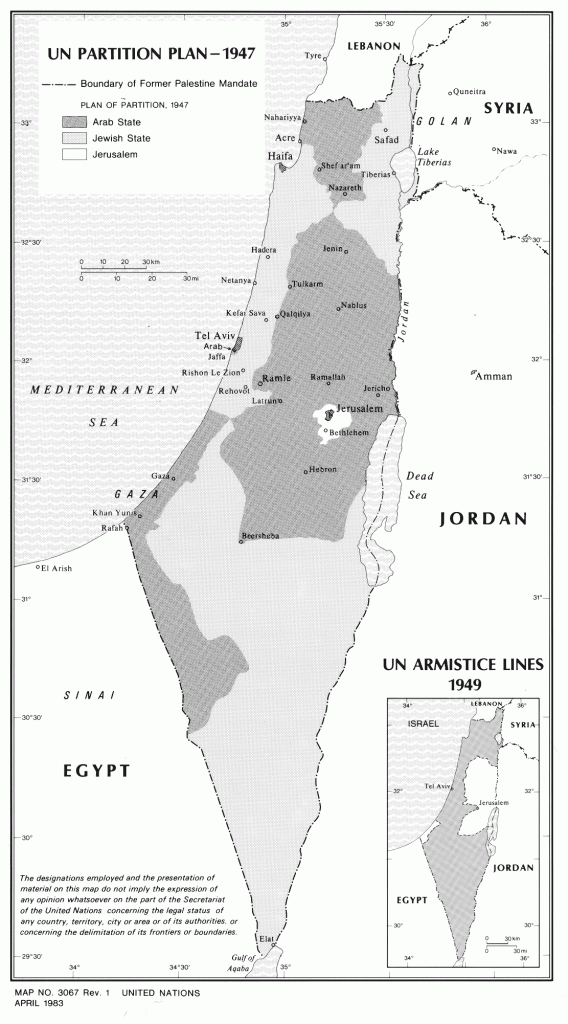


 politicswestchesterview
